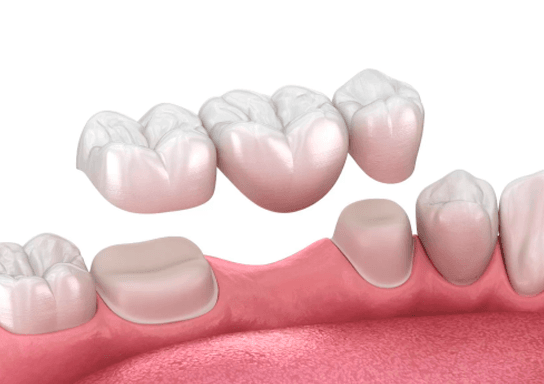
Not sure which dental bridge is right for you? What is a dental bridge? Explore the types,
benefits, and cost factors to make an informed decision.
Glossary: Translation from Medical Terms to Non-Medical Words
It's imperative that you understand the following information, so here is a small glossary to
explain a few dental terms that are commonly used when talking about getting bridges for teeth.
Crown:
In dentistry, a crown (also called a cap) is a tooth-shaped covering fitted over a
cracked, broken, or weakened tooth. It provides the tooth with original strength,
functionality, and appearance, and typically is placed after root canal treatment or in
case a cavity is too large to fill. Crowns can also improve the look of discolored or
broken teeth.
Pontic:
Is part of the dental bridge, an artificial tooth that fills the gap left by a missing
tooth, supported by the natural teeth on either side.
Abutment:
They are connecting pieces that join the prosthesis (the bridge) to the dental implants.
Abutment Teeth:
This refers to the natural teeth or dental implants that support dental bridges or
dentures. They receive the forces of chewing, and work as anchors for the artificial
teeth.
How Many Dental Bridges Are There, and Which Are They?
If you’ve heard about bridges, you might have also learn that there are a few different types of
dental bridges. Each one serves its specific purpose, and it depends on different factors to know
and decide which one is the best for you.
There are four main types of Dental Bridges.
Traditional:
A traditional bridge is the most popular type of dental bridge procedure and can be used when you
still have natural teeth on each side of the gap.
It consists of one or more pontics held in place by two dental crowns fixed onto the natural teeth
on either side of the gap.
The surrounding abutment teeth on both sides need to be reduced in size to fit the crowns, which
are cemented into position, with the pontics filling the missing space, resulting in the full
denture restored.
Cantilever:
Cantilever bridge teeth are much like traditional bridges — but with a twist. While the traditional
bridge is supported by two natural teeth at each side, the pontic in a cantilever dental bridge is
held in place by a crown that is fixed to only one abutment tooth. Summarizing, you only need one
natural tooth next to the missing tooth gap for a cantilever bridge.
Maryland Bridge:
Like the traditional bridge, this one needs two abutments at each side to support the pontics;
however, the difference is in the framework. Instead of using crowns (caps) on the natural teeth,
Maryland Bridges utilize mostly metal or porcelain features with a porous surface for adhesion
onto the back of the adjacent teeth.
Implant-supported Bridge:
Like the name says, this type of bridge does not use crowns or framework like the previous ones;
this one works with dental implants meant to support the pontics (the bridge itself). While it
differs slightly from the rest, this dental bridge offers outstanding longevity. The implants are
placed in the space of each missing tooth to hold the bridge in place. Usually, this procedure is
divided into two parts:

The first one to surgically embed the implants into the jawbone.
-
The second takes place (depending on each person) 3 to 6 months after the first surgery,
and once the implant has fully healed and fused with the bone. Then, the actual bridge is
placed atop.
All types can be done as a 3-unit bridge or a 4-unit bridge, according to the needs and conditions
of the patient. The decision can also be based on preference, if the circumstances allow it.
What Are They Made Of
Once the purpose and use of each type is clear, the following questions may pop up in your head:
What are they made of? Which materials are used? The material of what’s going into your mouth,
especially if it’s a long-term treatment, is crucial. There are a few different options to choose
from, considering the aesthetic, durability, comfort, and budget, among other factors.
One of the most common materials is Porcelain. There are two types of porcelain: All-Ceramic, and
Fused-to-Metal. The first one has a very natural appearance, almost like natural teeth. It is
mostly used for front teeth because of its blending capacity among natural teeth. The latter is a
mix with metal for extra support and durability. This is commonly used in front and back teeth in
general.
Another material is Zirconia, which is made from zirconium dioxide, a type of ceramic that has a
natural-looking result, and it’s known for exceptional durability. Zirconia is also biocompatible
to prevent allergic reactions.
The last example is the All-Metal bridge for teeth. Another self-descriptive name one, this is made
from gold, palladium, or a base metal alloy. As you can imagine, it’s the most durable one. With a
lifespan of 15+ years when taken care of properly. This type of dental bridge can resist chewing
and biting force without chipping or cracking. However, since the look of the metal can be poorly
blended among natural teeth and is less desirable, this option is more commonly used on back
teeth, which are not as visible.
How to Know Which One Fits Me Best?
Although dental bridges are a great option, they’re not for everyone. A few factors are very
important when evaluating if you’re a candidate.
Age:
Dental Bridges are primarily used in people above 17 or 18. A dentist would rarely place one on a
child, even though it can happen, especially if the child has lost a permanent tooth.
Number of Missing Teeth:
A dental bridge can be the option from just one missing tooth, to 3 in a row. It is possible to
have bridges with up to 4 pontics, but they need more support from the lateral abutments.
Natural Teeth on Both Sides of The Gap
This is one of the most important factors when deciding which type of dental bridge suits you best.
Since the pontics (bridge) need support to hold them in place, they either need natural teeth at
the sides or implants to rely on. Here’s where the differences are most notorious.
-
Traditional: Needs natural teeth on both sides of the bridge.
-
Cantilever: Needs only one natural tooth on one side.
-
Maryland: Metal framework adhering to the back of adjacent teeth.
-
Implant-supported: Relies on implants for support.
Overall Health (teeth and gums)
A dental bridge is like a real bridge on the highway; it needs healthy pillars to hold it up. When
the pillars are not healthy or strong enough, the bridge collapses. In dentistry, your gums and
natural teeth are the pillars. If they are not healthy, the new bridge does not have a solid
foundation, and this can lead to issues such as loosening, discomfort, or further tooth loss. Here
is where the implants would make their appearance.
What Do You Want
At the end, it’s also up to personal preference.Some people may prefer a bridge that looks as
natural as possible, while others focus on long-lasting strength or cost-effectiveness. Sharing
your preferences with your dentist ensures that the option you choose is the one that truly fits
your lifestyle and expectations, as well as your budget.
Comparison: An Important Step in Research
To understand fully and know the best option according to your needs and preferences, it’s
important to know their differences.
| Material |
Pros |
Cons |
Best For |
| Porcelain (all-ceramic) |
Very natural appearance, blends with teeth, metal-free (good for allergies). |
Less durable than metal-based options, can chip or fracture. |
Front teeth where aesthetics matter most. |
| Porcelain-fused-to-metal (PFM) |
Strong and durable, good balance of strength and aesthetics, widely used. |
Metal underneath may show as a dark line near the gums over time. |
Front and back teeth, general use. |
| Zirconia |
Extremely strong, highly resistant to fracture, and looks tooth-colored. |
More expensive, harder to adjust, may wear opposing teeth slightly. |
Back teeth (high chewing force) and patients wanting strength + aesthetics.
Biocompatible to prevent allergic reactions. |
| All-metal (gold or alloys) |
Very durable, resistant to wear, requires less removal of tooth structure. Lifespan of
over 15 years. |
Metallic appearance, less aesthetic, can be costly if gold. Risk of allergies. |
Back teeth where strength is priority and aesthetics are less important. |
Dental Bridge vs Implant
If you’re already learning about Dental Bridges, maybe you’ve also heard about Implants. Although
they are similar, they have punctual differences. Meanwhile, most bridges cover the gap and are
supported by adjacent teeth; Implants require titanium posts that go into the jawbone to serve as
an artificial root. The main reason for an Implant is the lack of natural teeth to support the
pontics (fake teeth).
Implants can be a very long-lasting option; in some cases, even for life if the patient takes
proper care of their teeth and hygiene.
Dental Bridges are also long-lasting, but their lifespan is up to 15+ years, and they will need a
replacement after that.
Another essential factor to consider is pricing. While implants are a more permanent option, they
are also higher in cost and have a more invasive procedure when placing the posts into the
jawbone. Dental Bridges are more budget-friendly and non-surgical; therefore, they are less
invasive.
The final decision might be taken by the patient in the company of their dentist, combining both
preferences and needs.